
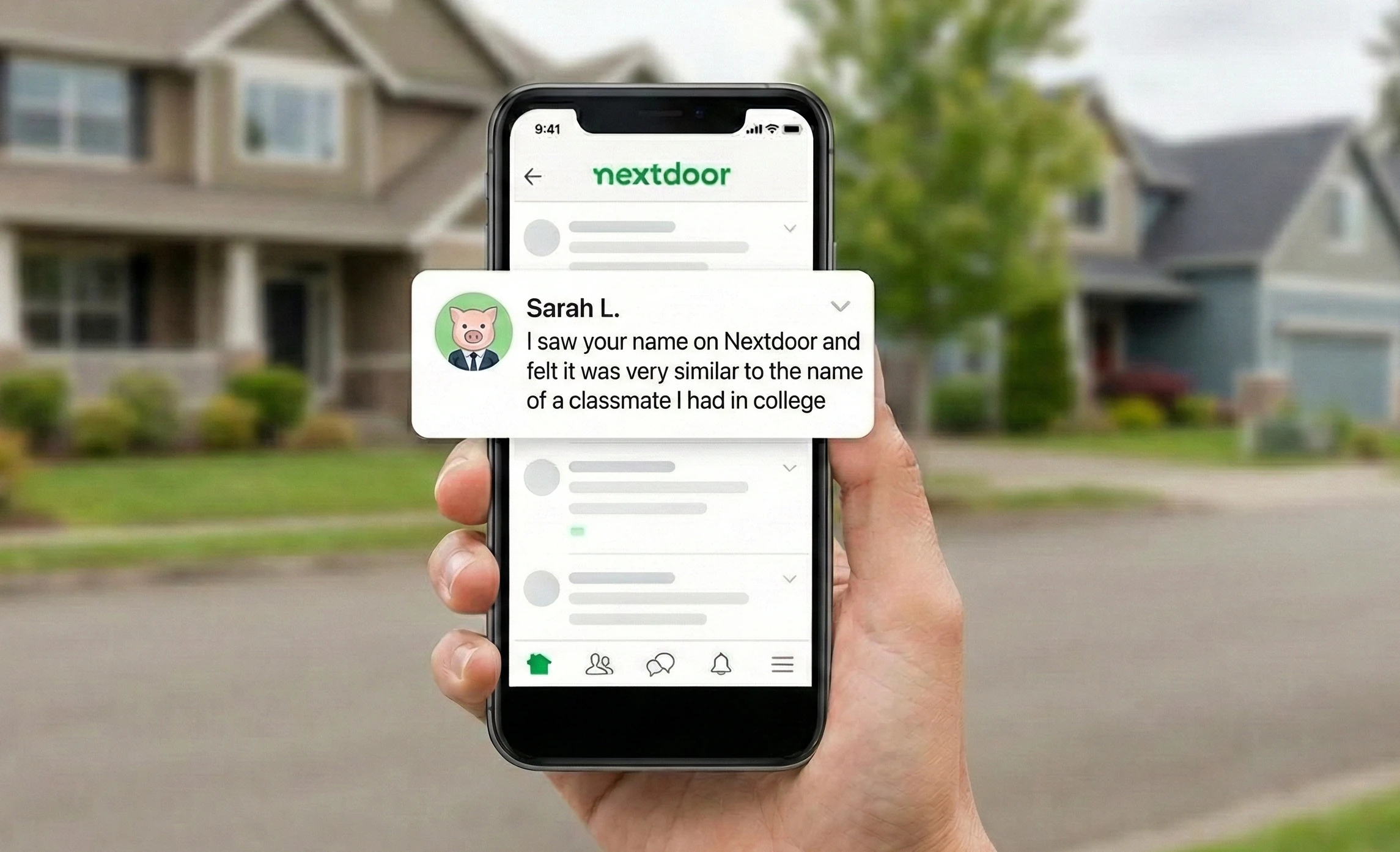
It started with a notification on my phone. Not a text, not a WhatsApp message from a wrong number, but a ping from Nextdoor—the app designed for finding lost cats and complaining about leaf blowers.
The message was from a user named “Sloane L.” It was polite, specific, and seemingly harmless.

“Hi Nick, wishing you all the best in the new year! I saw your name on Nextdoor and felt it was very similar to the name of a classmate I had in college, so I got a bit curious and wanted to ask whether you have a Chinese background.”
If you don’t know what you’re looking at, this looks like a friendly, if slightly awkward, neighbor trying to make a connection. But if you work in tech or follow cybersecurity, you know exactly what this is.
This is the opening line of a Pig Butchering scam (or Sha Zhu Pan). And it’s proof that these scammers are no longer just lurking on dating apps and encrypted messaging services—they are harvesting us in the places we feel safest: our local community boards.
The Anatomy of the Hook
Let’s break down Sloane’s message to me. It is a masterclass in social engineering scripts.
- The “Mistaken Identity” Trope: “I felt it was very similar to the name of a classmate…”
This is the most common entry point for modern scams. It creates a plausible reason for a stranger to contact you. It disarms your suspicion because they aren’t selling anything yet; they are just “checking” a fact. If you reply “No, that’s not me,” they will pivot immediately: “Oh, I’m so sorry! You just seemed so nice, I thought… well, since we’re both here, let’s be friends.” - The Cultural Filter: “Whether you have a Chinese background.”
This is a hallmark of the Sha Zhu Pan syndicates, many of which operate out of Southeast Asia. They often specifically target members of the Asian diaspora, leveraging shared language or cultural heritage to build trust rapidly (“guanxi”). They play on the idea of finding a connection in a foreign place. However, they are increasingly targeting everyone, simply using this question as a filter to see who is responsive.
I didn’t reply. Instead, I clicked on Sloane’s profile. That’s when the scale of the operation became terrifyingly clear.
The Double-Dip: The Direct Message vs. The Data Harvest
While “Sloane” was trying to groom me privately via Direct Message (DM), her public profile was running a completely different scam simultaneously.
She had a post up in the “East Ramona” neighborhood feed:

“I’m looking for a flexible helper—similar to a household assistant—for organizing, light maintenance, or general tasks as needed. Schedule is flexible, and reliability matters most. Please message me if interested.”
It looks like a generic job posting. But look closer. It’s vague. It offers “flexibility” (a keyword that attracts people who are desperate for cash or looking for side hustles). It requires no specific skills.
When I looked at the comments, my heart sank. 14 people had replied.
Many of them had publicly commented with their personal cell phone numbers: “I’m interested! Call me at 555-0199.”
Why They Are Harvesting Phone Numbers
This is the second prong of the scam. “Sloane” likely has no intention of hiring a household helper. That post exists for Lead Generation.
By posting a bait job listing, the scammer has just convinced 14 real, local people to voluntarily hand over their active cell phone numbers. These aren’t random numbers generated by a bot; these are numbers belonging to people who have self-identified as:
- Active users (they reply to posts).
- Financially motivated (they are looking for work).
- Trusting (they posted their number publicly).
These numbers will likely be added to a database and sold to other scammer rings, or targeted by “Sloane” herself via WhatsApp or text message a few days later.
“Every Entry Point”
We used to think we were smart enough to spot scams. We know not to send money to a “Nigerian Prince” via email. We know not to click suspicious links in texts.
But the Pig Butchering scam is different. It plays the long game.
- The Fattening: They spend weeks or months just talking to you. They ask about your kids, your job, your hobbies. They act like a friend.
- The Opportunity: Eventually, they mention how they made a lot of money recently on a specific investment (usually Crypto or Gold). They don’t ask you for money; they just show you their “success.”
- The Butchering: Once you express interest, they walk you through setting up an account on a fake investment platform that looks legitimate. You see your money “grow.” You put in more. When you finally try to withdraw it, the money is gone, and so is your new friend.
The scary evolution here is the platform. Nextdoor is a “high trust” environment. You have to verify your address to join. You assume the people there are your literal neighbors. Scammers are exploiting that verified trust. They are hijacking or creating accounts to bypass our mental defenses.
What To Do
If you get a message like this:
- Do Not Reply: Even saying “wrong person” flags your account as “active” to the scammers.
- Check the Profile: Does the user have a history of local activity, or just generic posts? Is their profile photo a generic attractive person (often stolen from Asian influencers)?
- Report the Account: Use the reporting function on Nextdoor immediately. Flag both the DM and the public job post.
- Warn Your Neighbors: If you see people posting their phone numbers on a suspicious job post, comment and warn them to take it down.
The internet is no longer a collection of safe harbors and dangerous alleys. The scammers are using every entry point—from LinkedIn job offers to Zillow inquiries to Nextdoor hellos.
Stay skeptical, even in your own digital backyard.
Leave a Reply